
The Answer Gap Index™ · Edition 2 · October 2026
Who AI recommends is not who Google ranks.
We asked Google’s AI Overview, Google’s AI Mode, ChatGPT and Perplexity to name the best local business, 720 times in September and 720 times again in October. Then we checked every business they named against Google’s map pack and top 10 for the same search.
- 2 editions
- 1,440 AI answers
- 4 engines
- 12 business types
- 3 cities
- 5 runs each
- Updated monthly
The Answer Gap Index™ is our ongoing measurement of the gap between who search engines rank and who AI recommends. Each edition re-asks the same questions and reports six measures, not a single score. Edition 2 adds the first month-over-month comparison.
Free · three minutes · no email. See which of six gaps costs you the most booked jobs, including whether buyers can find you.
Ghost Winners™
58.3%of the businesses AI recommended were in neither Google’s map pack nor its organic top 10.
Ghost WinnersIn the map packTop 10 only
Base: 640 recommended businesses, October 2026, each checked against five captures of the same city’s search results. September: 60.5% of 673. No detectable change.
TL;DR
The short version
October 2026, with September’s figure under each. Tap any number for the full finding.
- 0158.3%Sept 60.5%of the businesses AI recommended weren’t in Google’s map pack or top 10. Held.Finding 01 ↓
- 0240.5%Sept 36%of ChatGPT’s #1 picks were Ghost Winners™ — businesses Google didn’t rank. Held.Finding 02 ↓
- 0327%Sept 36%of searches showed Google’s AI Overview. Google’s AI Mode answered 97%. Held.Finding 03 ↓
- 0439%Sept 28%of the time, ChatGPT kept the same #1 pick across five identical runs. Held.Finding 04 ↓
- 053.6%Sept 6.2%of the time, ChatGPT, Perplexity and AI Mode agreed on the #1 business. Held.Finding 05 ↓
- 0627%up from 7%of ChatGPT’s picks cited the business’s own website. The one real change.Finding 06 ↓
What changed since Edition 1
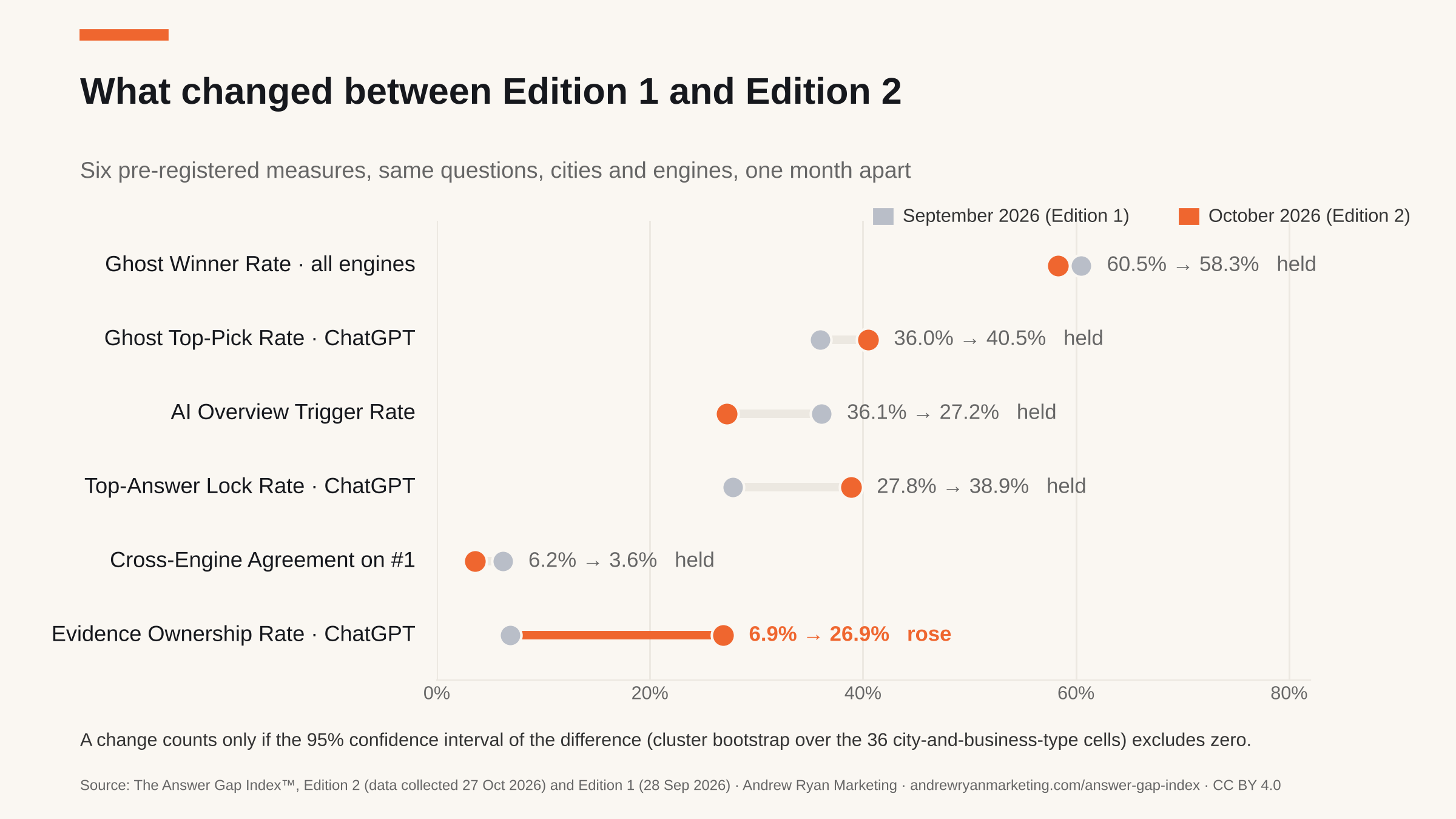
One measure moved. Five held.
A change counts only when it clears the test fixed before Edition 2 was collected. “Held” means the move is inside the noise.
- Ghost Winner Rateall engines60.5%58.3%held
- Ghost Top-Pick RateChatGPT36.0%40.5%held
- AI Overview Trigger RateGoogle36.1%27.2%held
- Top-Answer Lock RateChatGPT27.8%38.9%held
- Cross-Engine AgreementChatGPT, Perplexity, AI Mode6.2%3.6%held
- Evidence Ownership RateChatGPT6.9%26.9%rose
71% of October’s Ghost Winners™ were already Ghost Winners in September. The gap is mostly a standing condition, not a one-day fluke.Finding 01 ↓
Free chart for download
Cite this study
Andrew Ryan Marketing (2026). The Answer Gap Index™, Edition 2: 720 AI answers compared with Google’s local rankings, with Edition 1 as the baseline. Data collected 27 October 2026. https://andrewryanmarketing.com/answer-gap-index/
Use it freely. Just link back. The numbers, charts and data are licensed CC BY 4.0: share or adapt them with credit to Andrew Ryan Marketing and a link to this page.
Edition 1 (data collected 28 September 2026) stays citable as “Andrew Ryan Marketing (2026). The Answer Gap Index™, Edition 1: 720 AI answers compared with Google’s local rankings.” Its summary: Edition 1 PDF.
Edition 3 is collected in late November 2026 with the same questions, cities and engines, so every measure can be compared.
Ranking helps. It doesn’t decide who gets named.
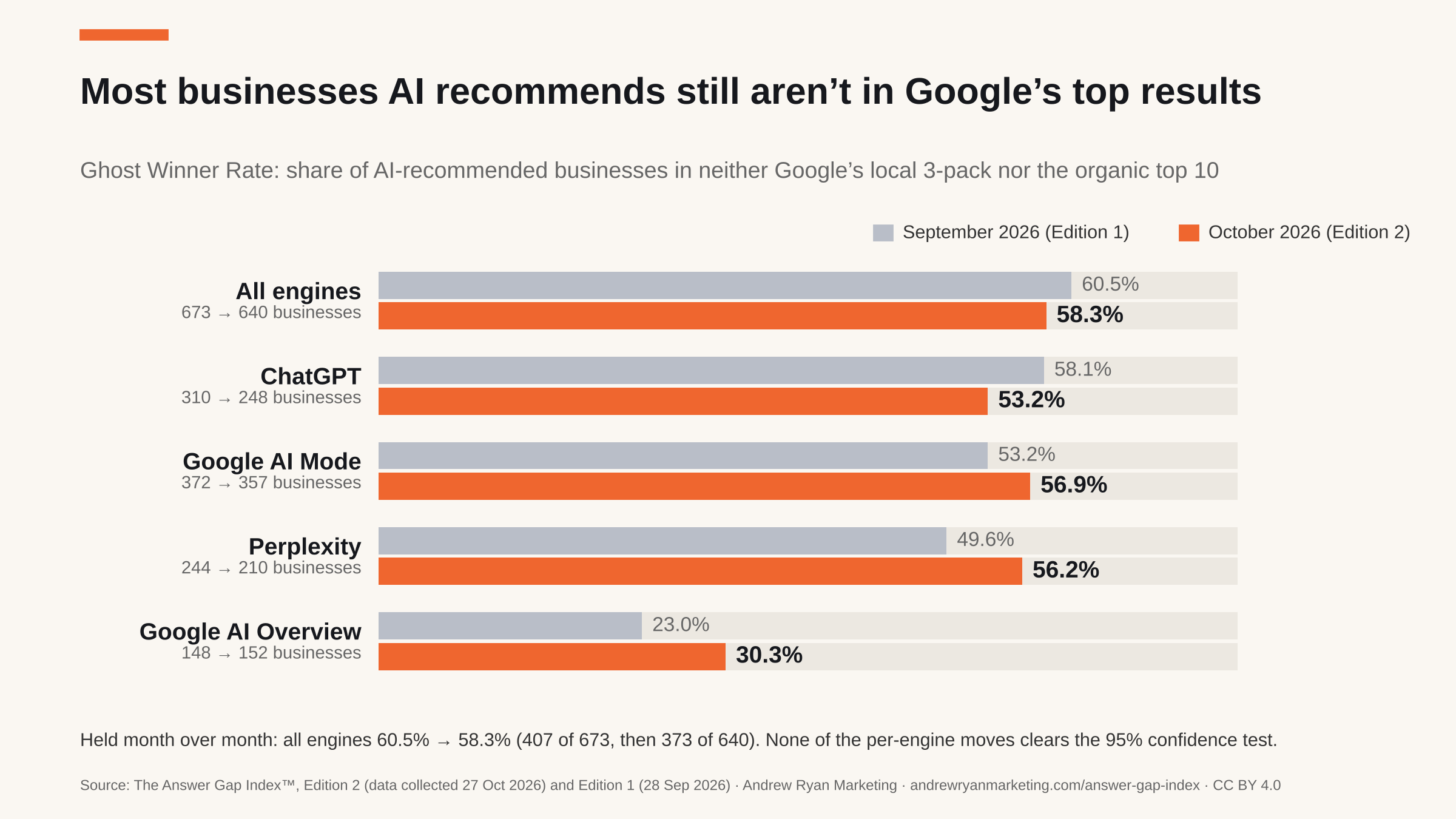
For every business an engine recommended, we checked whether it held a spot in Google’s local 3-pack or organic top 10 for the same search — in any of five captures. The orange share is the businesses that held neither. We call them Ghost Winners™. October 2026 figures, with September’s beside each.
In the map packTop 10 onlyNeither (Ghost Winner)
The short answer: 53.2% of the local businesses ChatGPT recommended in October were in neither Google’s map pack nor its organic top 10 for the same search (September: 58.1%). Across all four engines, 58.3% of the 640 businesses named were Ghost Winners, against 60.5% in September: no detectable change. The rate held across home services (60.9%), professional services (52.7%) and B2B services (61.6%).
Persistent Ghost Winners™. Of October’s Ghost Winners that also appeared in September’s answers for the same search (207), 147 were already Ghost Winners then. Being recommended by AI while absent from the rankings is mostly a standing condition, not a one-day fluke.
Observed by Andrew Ryan Marketing, 27 October 2026 (Edition 2) and 28 September 2026 (Edition 1). Unique businesses per city and engine; the 49 October businesses we could not resolve to a website are excluded, which lowers the Ghost rate rather than raising it. None of the per-engine moves clears the 95% confidence test.
Free chart for download
The #1 pick is often a Ghost Winner.
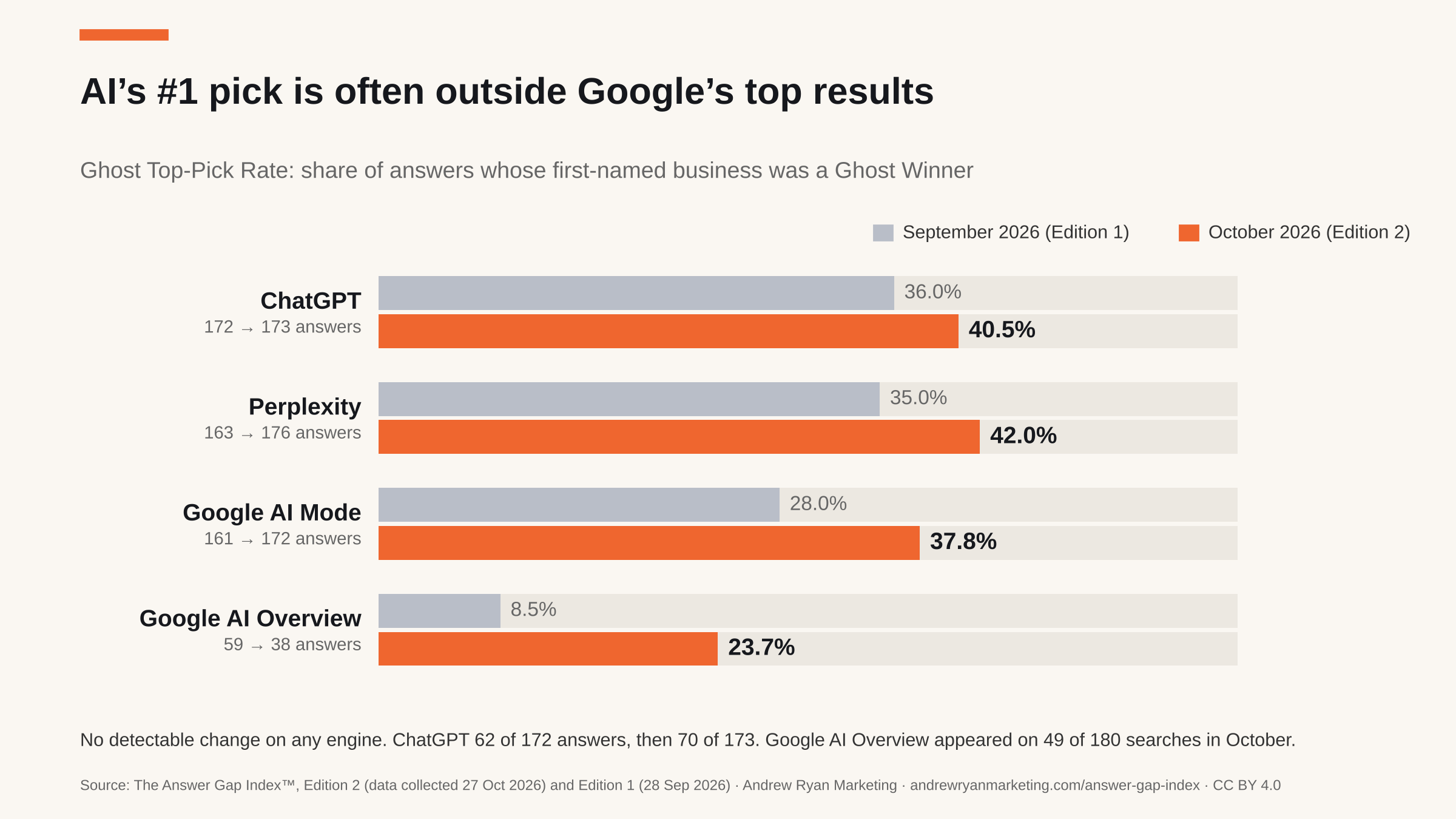
The first business an answer names is the one a buyer sees first. We checked how often that first pick held no map-pack or top-10 spot for the same search.
October 2026, with September beside each; none of the four moved more than chance allows. Google’s AI Overview is still the exception: its first pick was in the map pack about half the time (73% in September).
- ChatGPT70 of 173 answers · Sept 36%40.5%
- Perplexity74 of 176 answers · Sept 35%42.0%
- Google AI Mode65 of 172 answers · Sept 28%37.8%
- Google AI Overview9 of 38 answers · Sept 8.5%23.7%
Free chart for download
Google’s AI Overview mostly sits these searches out.
On “best [business] in [city]” searches, the classic AI Overview appeared on about a quarter of October’s searches, after about a third in September: a drop inside the noise, so it counts as held. Google’s AI Mode answered almost every time.
So the AI answer a local buyer is most likely to get from Google comes from AI Mode, where 56.9% of the businesses named were Ghost Winners.
The top spot rarely holds.
We asked each engine the same question five times. Each strip below is the 36 city-and-business pairs; a lit square is a pair where the same business came first every time.
October 2026, with September’s count beside each; none of the three moved more than chance allows. Perplexity was measured through its API at default settings, not the consumer app, which likely explains its steadiness. The AI Overview never appeared in all five runs for any pair, so it has no lock rate.
- ChatGPTsame #1 every run · 14 of 36 · Sept 1039%
- Google AI Modesame #1 every run · 2 of 36 · Sept 16%
- Perplexity (API)same #1 every run · 26 of 36 · Sept 2772%
The engines don’t agree with each other.
Same city, same question, same moment. We compared ChatGPT, Perplexity and Google AI Mode side by side across the 167 October runs where all three named businesses.
September beside each; neither figure moved more than chance allows. Being named by one engine says little about the other two. AI visibility has to be measured engine by engine.
ChatGPT now cites the business’s own site for one pick in four.
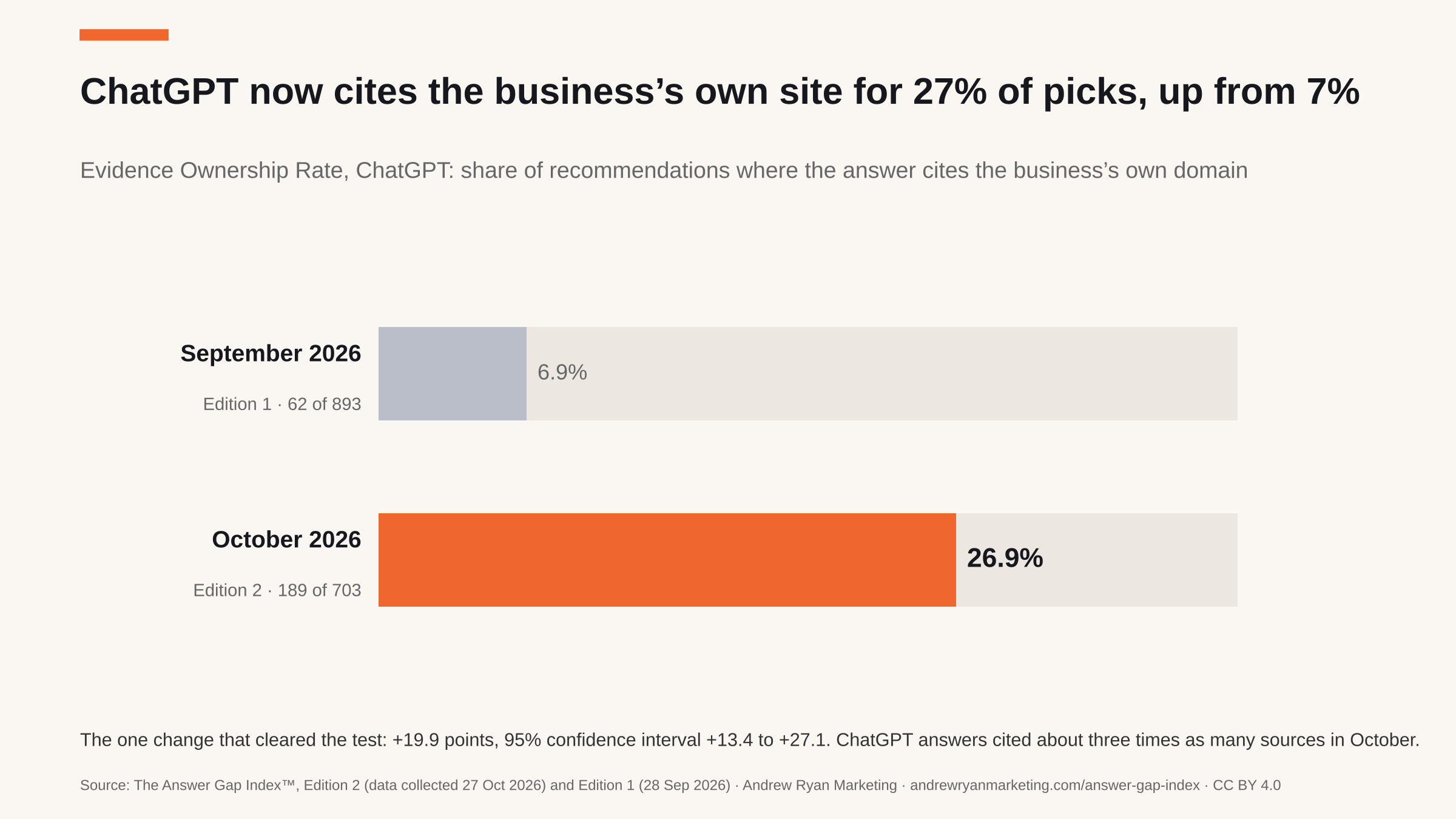
For every recommendation, we checked whether the answer cited the business’s own website, or only other sites — directories, “best of” lists, review platforms and forums.
The short answer: 27% of ChatGPT’s local recommendations in October came with a citation to the business’s own site, up from 7% in September. It is the one measure of six that moved more than chance allows (95% confidence interval +13 to +27 points), and it moved the same way for home, professional and B2B services. Most of the proof still lived somewhere else.
Answer cites the business’s own site · October 2026
- ChatGPT189 of 703 · Sept 7% 27%
- Google AI Mode89 of 744 · Sept 21% 12%
- Google AI Overview54 of 189 · Sept 54% 29%
- Perplexity (API)542 of 872 · Sept 77% 62%
Counted per recommendation, across all runs. Engines don’t tie each citation to a specific business, so this measures whether the answer as a whole cited the business’s own site. Perplexity, the AI Overview and AI Mode exposed fewer citations per answer in October than in September (Perplexity about half as many, AI Mode about a quarter), which lowers this per-answer measure on its own; their lower October figures are reported here but not counted as changes. ChatGPT went the other way, citing about three times as many sources per answer.
Free chart for download
Follow-up study · Why they get named
What AI-named businesses have in common.
We took the businesses Google already showed in its map results for the same 36 searches, then compared the ones AI named with the ones it never named — 25 factors each, with the method fixed before we collected anything.
- 106vs 64median Google reviews: named vs never named.
- 9vs 6reviews in the last six months, out of their newest 20.
- 206vs 164other websites linking to them (referring domains).
- 4.9vs 4.9star rating. No difference at all.
- 0.66Reviews, recent reviews and links, trained on two cities, predicted who AI named in the third. 0.5 is a coin flip; 1.0 is perfect. Star rating alone: 0.58.
- 39%of the sites ChatGPT cited were “best of” and ranking lists. For Google’s AI answers, about half were businesses’ own websites.
- ~50%of ChatGPT’s and Perplexity’s picks were named on a third-party page the answer cited. A floor: 36% of those pages blocked our reader.
Made no difference
- Star rating
- Schema markup
- Homepage length
- Knowledge panel
- Directory listings
- Reddit mentions
- Owner replies
- Review wording
- City in page title
And the Ghost Winners™? On these signals they looked like the named businesses Google did show. What set them apart was distance: a median 6.8 miles from the city-centre search point, against 1.7. AI recommendations appeared less constrained by distance than Google’s local results — but moving the search point explained only part of the gap (see Method).
Follow-up study, same 36 searches, 28 September 2026. 482 businesses: 246 Google showed and AI named, 117 Google showed and AI never named, 119 strong Ghost Winners. Medians shown. These are correlations: they show what AI-named businesses have in common, not what makes AI name them.
What it means for a local business
Page one gets you found.
It doesn’t get you named.
- A
Check the answer, not just the rank.
A ranking report can’t tell you whether AI names you. The only way to know is to ask the engines your buyers use, the way your buyers ask.
- B
Your proof still has to live off your site.
AI leaned on directories, lists, reviews and forums far more than on the business’s own website, though ChatGPT now cites the business’s own site for one pick in four. What others say about you is most of the evidence it reads.
- C
One screenshot proves nothing.
The #1 answer changed from run to run and from engine to engine. Being named has to be measured repeatedly, on every engine that matters.
Free · three minutes · no email. Four numbers you already know show which of six gaps costs you the most booked jobs.
Already know your gap? Book Your 20-Minute Gap Review →
Method
How we measured it
The method was fixed and written down on 28 September 2026, before any data was collected, and Edition 2 was pre-registered the same day, including the test for change. Every October number on this page comes from one collection on 27 October 2026, and every September number from one collection on 28 September 2026. The follow-up study section is labelled as such.
The study
- Question
- “best [business type] in [city, state]” — the same wording on every engine, no follow-ups.
- Engines
- Google AI Overview, Google AI Mode, ChatGPT and Perplexity (sonar, via API with web search).
- Business types
- Home: roofer, plumber, HVAC, electrician. Professional: family law attorney, CPA firm, dentist, physical therapist. B2B: commercial cleaning, managed IT, business insurance broker, commercial printing.
- Cities
- Denver CO, Boise ID and Chattanooga TN — a large, a mid-size and a smaller metro.
- Runs
- Five per city, business type and engine: 720 answers per edition, all on one day (28 September 2026 for Edition 1, 27 October 2026 for Edition 2), US English, desktop.
- Rankings
- Google’s local 3-pack and organic top 10 for the same search and city, captured five times. Edition 2 also captured four more points about six miles north, south, east and west of each centre, on the same day.
- Change test
- A change between editions counts only if the 95% confidence interval of the difference, from a cluster bootstrap over the 36 city-and-business-type cells (2,000 draws, both editions resampled on the same cells), excludes zero. Otherwise the measure is reported as held. If home, professional and B2B services move in opposite directions, no pooled change is claimed.
What to keep in mind
- The Ghost Winner count is conservative: a business counts as ranked if it appeared in the map pack or top 10 in any of five captures.
- Businesses were identified from each answer, then matched to their own websites; the 49 we could not resolve in October (7%; 60 in September, 8%) are left out of the Ghost rate.
- Search location, tested: the headline figures use Google results from each city’s center. In Edition 2 we also captured four more points about six miles north, south, east and west on the same day as the answers. From all five points, 50.0% of AI-recommended businesses still weren’t in Google’s top-3 map box or top 10 (centre only: 58.3%), and 37.7% weren’t in Google Maps’ top 10 from any point. Edition 1’s re-run, captured a few hours after its answers, gave 54.7% and 27%.
- ChatGPT and Perplexity were located to the US, with the city in the question. Google was located to each city.
- Perplexity was measured through its API, not the consumer app.
- One day per edition, three cities, desktop only. Two editions a month apart are the first two points of a benchmark, not a trend; each edition re-runs the same questions so changes over time can be measured.
- Citations per answer changed: Perplexity, the AI Overview and AI Mode exposed fewer source links per answer in October than in September (Perplexity about half as many, AI Mode about a quarter), while ChatGPT exposed about three times as many. The Evidence Ownership Rate is measured per answer, so fewer links lower it on their own. The three lower October figures are reported but not counted as changes; the ChatGPT rise cleared the test and is.
- Two small Edition 2 artifacts: ChatGPT’s answers now embed image links hosted by OpenAI, which count as a cited domain but never as the business’s own site (8 of 703 ChatGPT recommendations move from “cited other sites” to “cited nothing” if they are removed; the rate is unchanged at 27%). And 5 of the 180 extra Google Maps captures (all Boise) failed repeatedly; they affect only the five-point Maps figure, downward if anything.
- Collected through the DataForSEO API. None of the businesses in the answers are Andrew Ryan Marketing clients.
The six measures, defined
Six measures, not a single score. Every edition reports them the same way, so the numbers can be compared over time. October 2026 first, then September.
- Ghost Winner RateThe share of AI-recommended businesses that were in neither Google’s map pack nor its organic top 10 for the same search.Edition 2: 58.3% · 373 of 640 businesses · Edition 1: 60.5% · held
- Ghost Top-Pick RateHow often an engine’s #1 recommendation was a Ghost Winner™.Edition 2: ChatGPT 40.5% · 70 of 173 answers · Edition 1: 36% · held
- AI Overview Trigger RateHow often Google showed an AI Overview for the search.Edition 2: 27% · 49 of 180 searches · Edition 1: 36% · held
- Top-Answer Lock RateHow often the same business was named #1 in every run of the same question.Edition 2: ChatGPT 39% · 14 of 36 cells · Edition 1: 28% · held
- Cross-Engine AgreementHow often ChatGPT, Perplexity and Google AI Mode named the same #1 business.Edition 2: 3.6% · 6 of 167 city-runs · Edition 1: 6.2% · held
- Evidence Ownership RateHow often the AI answer cited the recommended business’s own website, rather than only other sites. Measured per answer, not per citation.Edition 2: ChatGPT 27% · 189 of 703 recommendations · Edition 1: 7% · rose
The PDF is a branded three-page summary of Edition 2 with the September comparison. The CSV has 288 rows: every city, business type and engine for both editions, with runs, businesses named, Ghost Winners and how often the #1 pick repeated. Free to use with a link back to this page. Previous editions: Edition 1 summary (PDF, 28 September 2026).
Questions
Frequently asked
Does ranking on Google get a local business recommended by ChatGPT?
Not reliably. In the Answer Gap Index (720 AI answers in September 2026 and 720 more in October), 53.2% of the businesses ChatGPT recommended in October were in neither Google’s local 3-pack nor the organic top 10 for the same search, after 58.1% in September. Ranking helps, but it does not decide who AI names.
What is a Ghost Winner?
A business an AI engine recommends while it holds neither a Google local 3-pack spot nor an organic top-10 result for the same search. In Edition 2 of the Answer Gap Index (October 2026), 58.3% of the 640 AI-recommended businesses we could resolve were Ghost Winners, after 60.5% in Edition 1; 71% of October’s Ghost Winners were already Ghost Winners in September.
What do local businesses that AI recommends have in common?
In our follow-up study of 482 businesses (September 2026), among businesses Google already showed in its map results, the ones AI named had more Google reviews (median 106 vs 64), more recent reviews and more websites linking to them than the ones it never named. Star rating, schema markup and homepage length made no difference. These are correlations, not proof of cause.
Do ChatGPT, Perplexity and Google AI recommend the same local businesses?
Rarely. Across 167 city-runs in October 2026, ChatGPT, Perplexity and Google AI Mode named the same business first 3.6% of the time (6.2% in September), and in 63% of runs they had no recommended business in common.
Where does ChatGPT get its local business recommendations?
Mostly from other websites, but less so than a month earlier. In October 2026, 27% of ChatGPT’s recommendations came with a citation to the business’s own site, up from 7% in September; the rest were supported by third-party sources such as directories, rankings and review sites.
How was the Answer Gap Index measured?
The same prompt, “best [business type] in [city, state]”, was sent to Google AI Overview, Google AI Mode, ChatGPT and Perplexity five times each for 12 business types in Denver, Boise and Chattanooga, on September 28, 2026 for Edition 1 and again on October 27, 2026 for Edition 2. Named businesses were matched against five captures of Google’s local 3-pack and organic top 10. The method, and the test for change between editions, were fixed before data collection.
What changed between Edition 1 and Edition 2 of the Answer Gap Index?
One of the six measures moved more than chance allows: ChatGPT’s Evidence Ownership Rate rose from 7% to 27%, so ChatGPT now cites the recommended business’s own website for about one pick in four. The other five held: the Ghost Winner Rate at about 60% (60.5%, then 58.3%), ChatGPT’s Ghost Top-Pick Rate at about 40% (36%, then 40.5%), the AI Overview Trigger Rate at between a quarter and a third of searches (36%, then 27%), ChatGPT’s Top-Answer Lock Rate at about a third of city-and-business pairs (28%, then 39%) and Cross-Engine Agreement in the low single digits (6.2%, then 3.6%). A change counts only when the 95% confidence interval from resampling the 36 cells excludes zero.